Nine films, nine worlds, more than twenty outfits and three bodies, and she still reads as one person. None of it used a character-reference feature, a trained model or a face swap (THE CAKE IS NOT A LIE did put her face back to her design sheets with an image-model edit, on each picked frame she is in, and AERO put her into Midjourney's worlds from her design sheet the same way). Her identity is a paragraph of text, written into every prompt, plus a handful of habits for checking what comes back. (WHITEPILL, the seventh, also gave its video models a sheet of her face: below. THE CAKE IS NOT A LIE, the eighth, made her face porcelain and gave it three bodies: Three bodies, one face. AERO, the ninth, gave every video take with her face her design sheet beside its first frame.)
The short version
- Write her identity into every prompt, in the same words. Midjourney v8.2 has no character reference, and it doesn't need one if the text never changes. Copy the canon text below; don't paraphrase it.
- Use two lengths. The full text for close and medium shots, a short one for full length and wider. With the full text, Midjourney crops in to her face whatever the framing says.
- Pin her ethnicity and her age. Without the ethnicity, Midjourney changed it from shot to shot. Without a stated age (late twenties, an angular adult face), it drifts her toward a teenager. Never write "young".
- No face images as references for her, except for things that are not her body: a porcelain mask of her face, and her game avatar in AIRPLANE MODE, a separate character whose front view is its own image prompt, never mixed into her photographic prompts. The one exception for her own face came last, in a video model: DON'T LET ME SCROLL's final repairs held her face to a reference the director picked (below). WHITEPILL went further: every video take of hers had her whole face sheet as a reference, beside the canon text. THE CAKE IS NOT A LIE put her back on her sheets with an image-model edit after Midjourney, and gave each video take one image of her, its first frame. AERO put her into every Midjourney world from her design sheet with an image-model edit, and gave every video take with her face that sheet as a second image.
- The head never changes; the clothes always can. Hair, streak, clip, mic and face are the constants. Each world gets its own wardrobe. In THE CAKE IS NOT A LIE even her face is porcelain, and the bob, the streak and the clip carry her.
- Fix the source, not the frame. Re-roll or correct a plate with an image-edit model, then re-make anything made from it. Nothing is painted by hand.
- Check every plate before it feeds a video: one clay streak, the star clip, the mic, an adult face, natural anatomy, no text.
- In motion, the first frame carries her. Seedance keeps her identity when her Midjourney plate is the first frame and the prompt says what must stay. So did Wan 3.0 in DOWNFORCE, with the canon text pasted into the prompt, and in DON'T LET ME SCROLL, where Seedance video edits later changed her clothes and kept her face and every move. WHITEPILL's takes had no first frame of her at all: her face sheet, her dress from four sides and the canon text carried her through every shot.
The canon text
Close and medium shots:
a 28-year-old Caucasian American woman with a grown-up angular face, defined cheekbones and a strong jawline, pale skin and light freckles, a glossy black blunt jaw-length bob with heavy straight bangs and one clay-orange streak through the bangs, a small flat clay-orange eight-pointed star hair clip, a thin headset microphone at her cheek
Full length and wider:
a Caucasian American woman in her late twenties with pale skin and a glossy black blunt bob with heavy straight bangs and one clay-orange streak, a thin headset microphone
Then the wardrobe of the look, then what she is doing and where. The character page has every look's wardrobe text and the exact wording each film used.
How the identity text was found
ESCAPE VELOCITY started with a casting call: three hair directions (platinum, black, clay-orange), each as a turnaround, a catwalk shot and an expression sheet. The black bob with one clay streak won because its silhouette reads at thumbnail size and the clay stays a small accent.
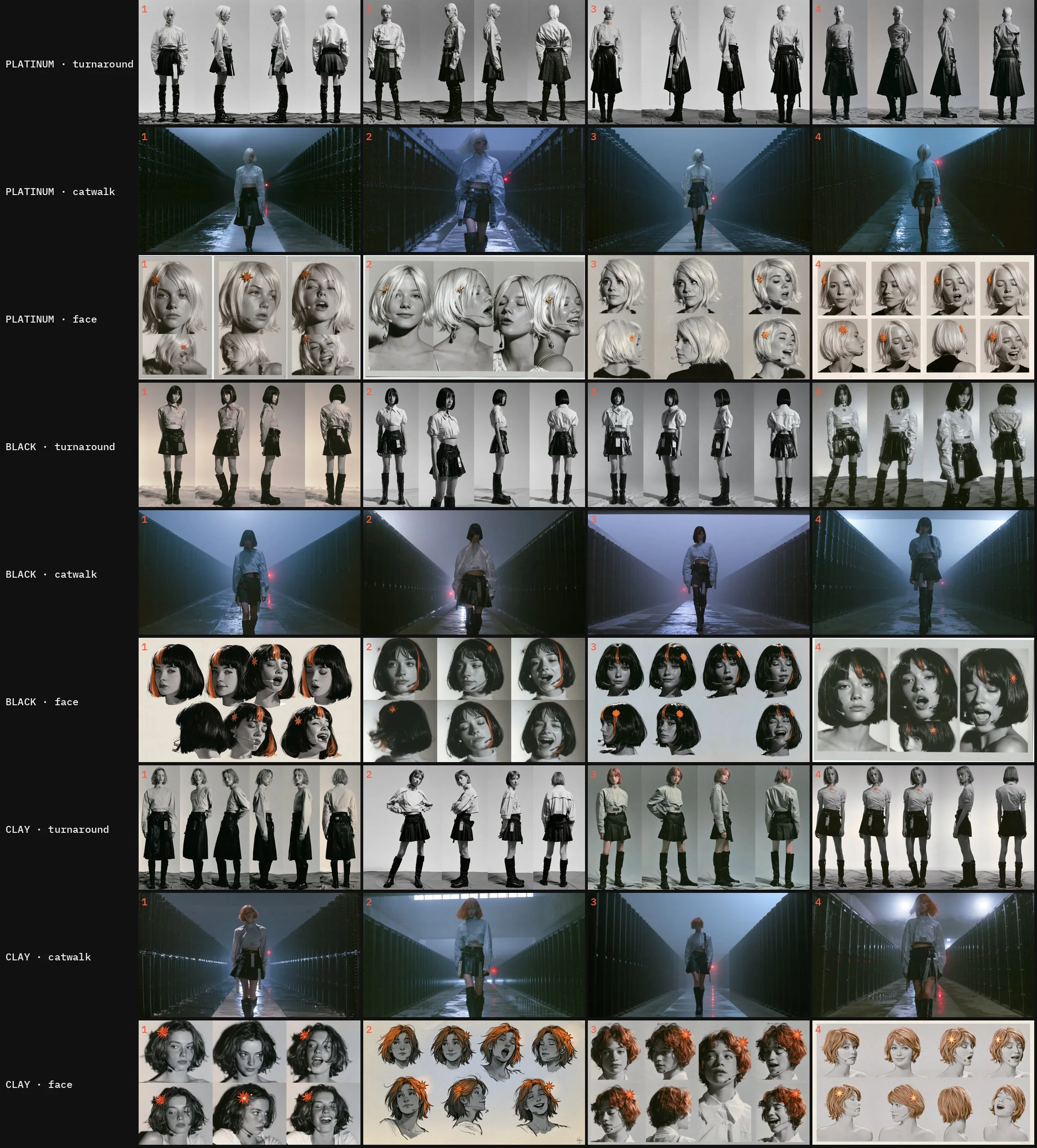
Then three ways of holding her identity were tried:
- Identity passes in an image model (redrawing each Midjourney plate with her face). They drifted from the Midjourney look and refused some poses. The director's note: "Gpt is diverging way too much".
- Face sheets as image prompts. A whole sheet imported its multi-head layout; a single face over-conditioned. "Far away it gives her big head": a close-up-sized head on a distant figure.
- Prompt text only. The canon written into every prompt, plus an explicit descriptor of her ethnicity and skin. This is what worked, and every image of her since was made this way.
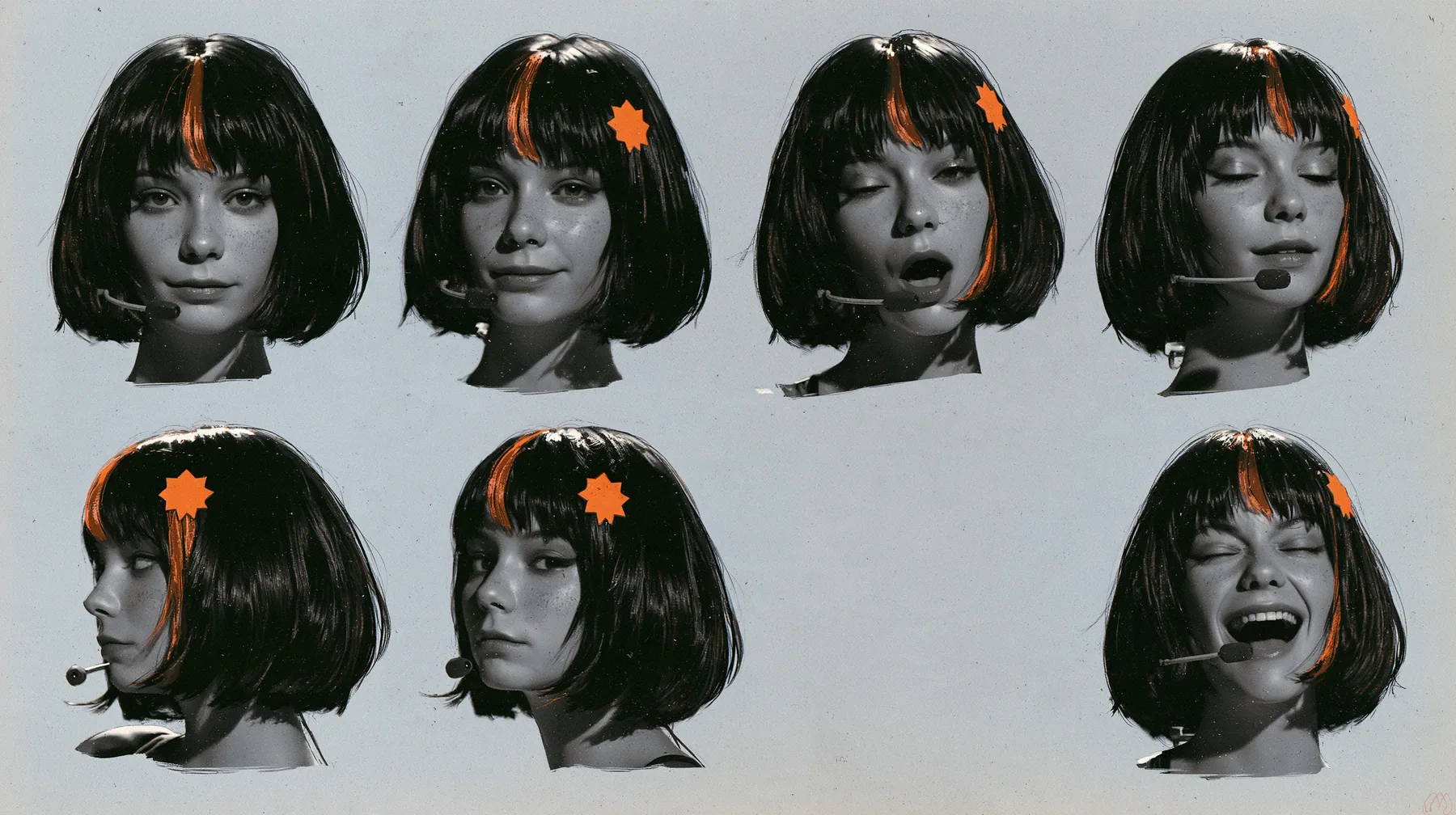
The face sheets still matter, as a record of who she is. They were never used as the image.
Distances
Each framing needs a different amount of her. A distance set, the same look in a plain studio from close-up to wide, shows how much face survives at each scale and which text to use.
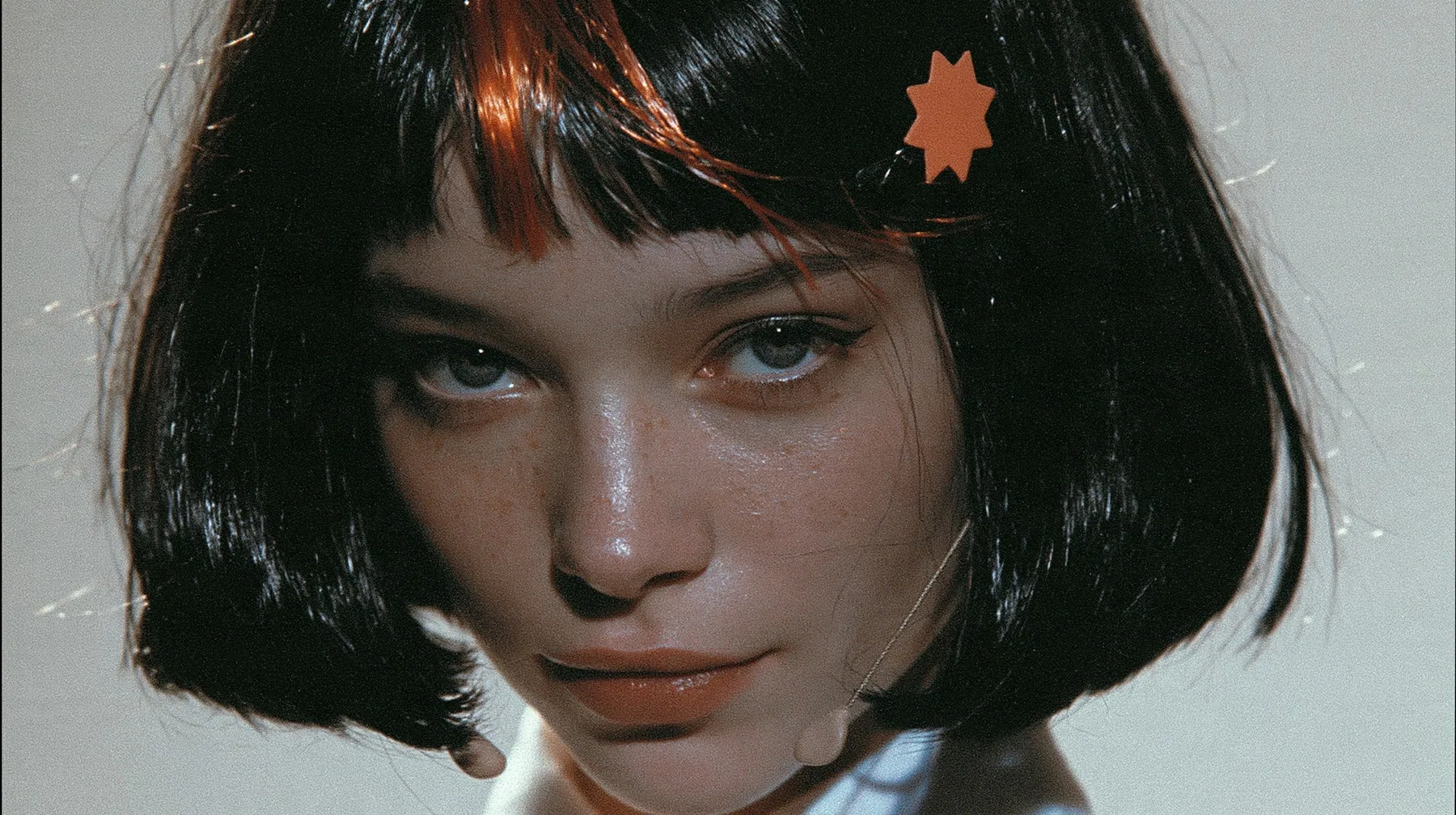
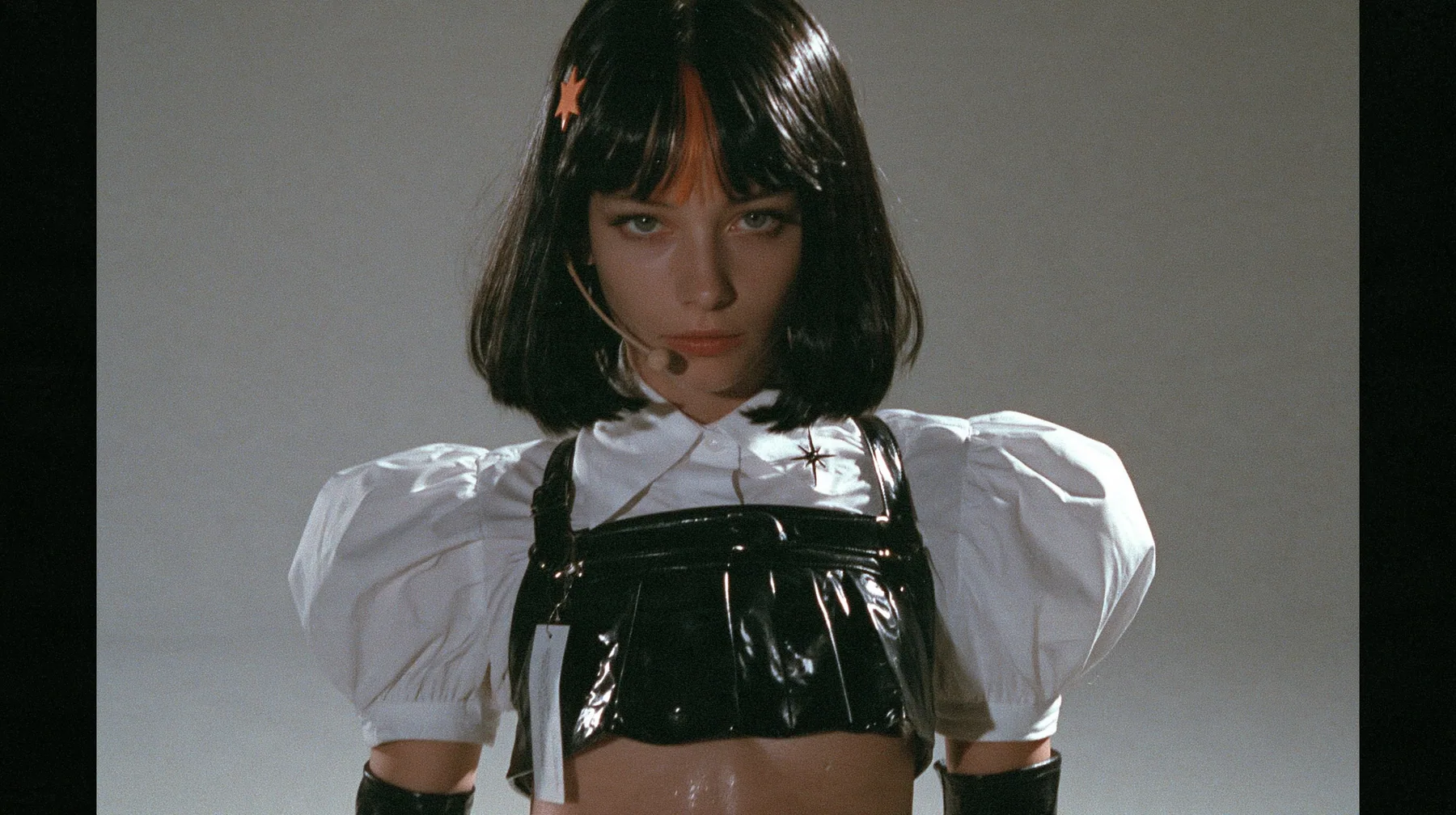
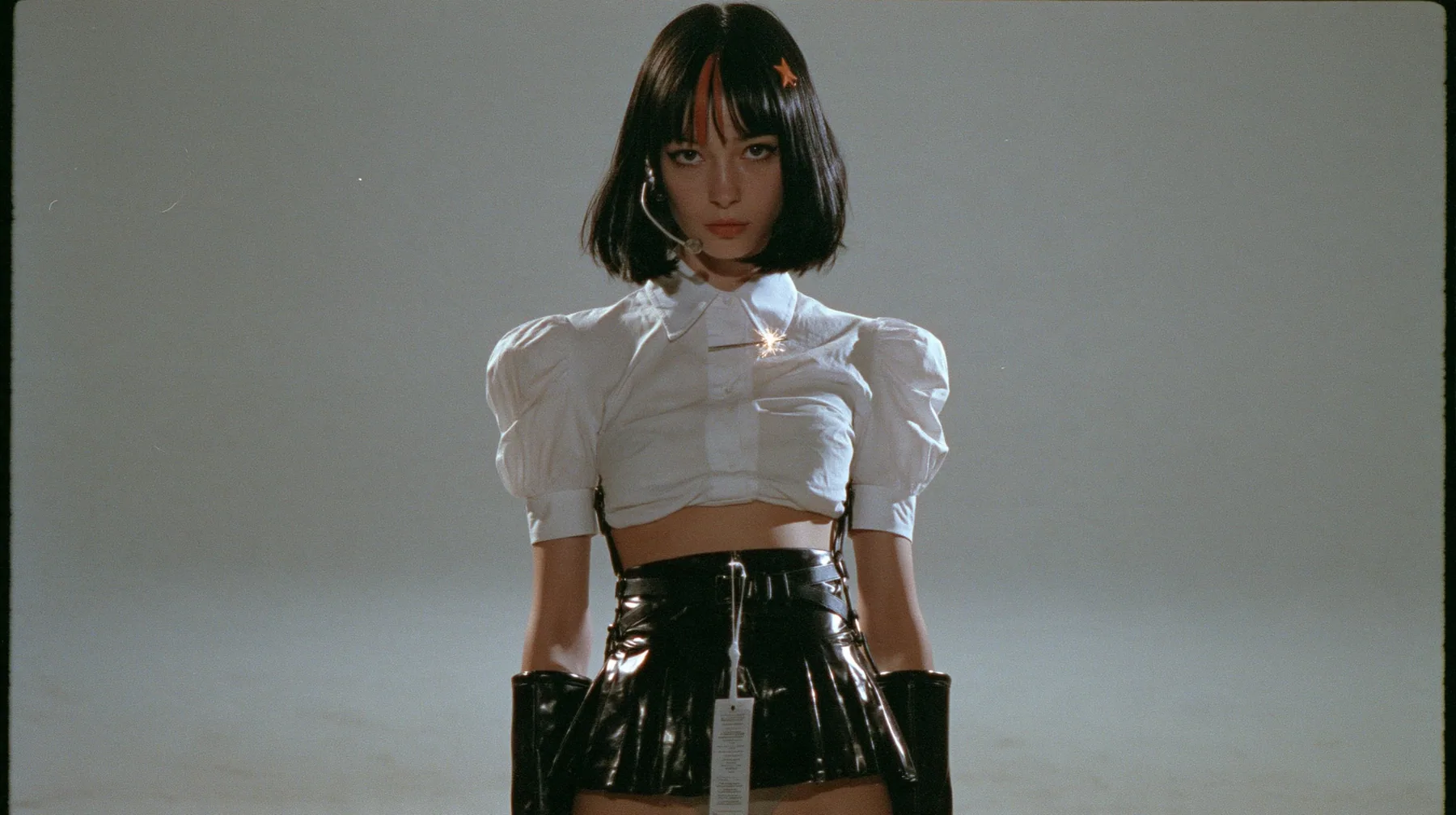
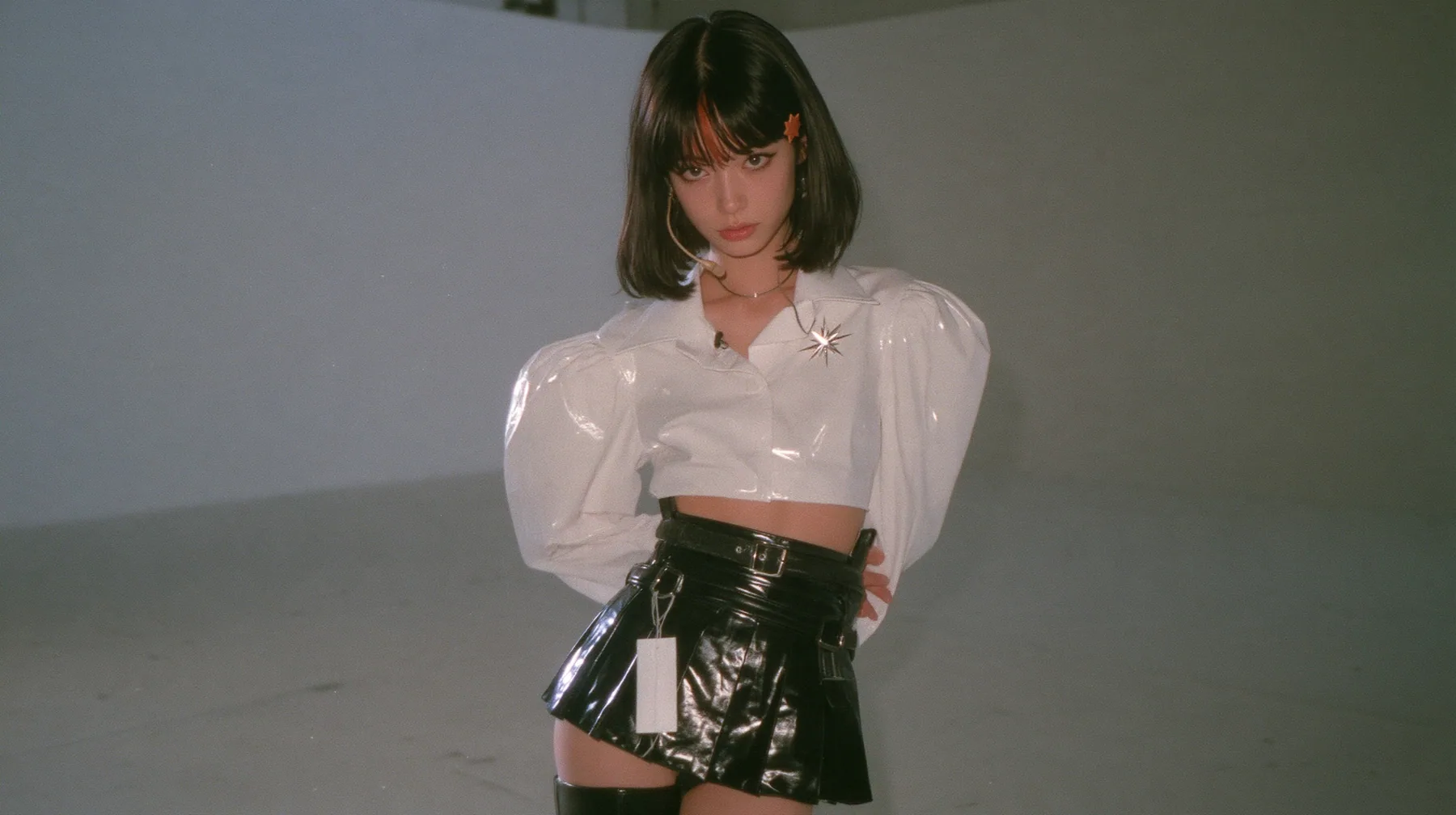
The director's rule: "far away face doesnt matter as much". Wide and extreme wide plates get the short text, or just the bob, the streak and the look.
Age
Midjourney's version of her, pale and freckled with a blunt bob and bangs, drifts toward a teenage face: big eyes, a small chin, a soft jaw. The word "young" makes it worse. ESCAPE VELOCITY's text said "young"; CLODYSSEY and BLISS said "in her mid-twenties"; plates still came back reading teenage, and were rejected. The current text states her age, 28, and an adult bone structure, and plates where she reads under about 25 are thrown away before anyone builds on them. AIRPLANE MODE used it ("in her late twenties"), and still re-made four first frames that read young; its re-stills say "in her early thirties" or "a 32-year-old grown woman". DOWNFORCE pasted the canon verbatim into every plate: in its look test she read adult in all but one image, which read a bit young and was dropped. The video model can still drift her: in one take a crash zoom after about 4.5 s left her rounder and younger, without the streak or the clip, and the film uses only the seconds before it. Its reviewers judged one more take, a close-up, to read young at its size; a re-roll from a sibling plate was planned but not run, and that take is in the film.
DON'T LET ME SCROLL pasted the canon into every plate too, and its looks still pulled her younger. The production's screen of the second round's looks found three images that read young, and a mustard pinafore with knee socks and Mary Janes that read young in every image; the pinafore was dropped. This site's gallery leaves out the pinafore and twelve single images for a soft round face, very large eyes and full cheeks (two of the production's three among them), and keeps their siblings. One of the twelve is in the film, cropped small as her avatar on the posts.
WHITEPILL wrote her age into the dress prompts. Its first dress stills came from an image-edit model, and the director: "i like 3 but remake the image and just specify to make sure shes like 30 years old to gpt image and make appropriate edits". The Midjourney batch that found the dress wrote "a 30-year-old" in every prompt written from text (its other jobs re-dressed two of DON'T LET ME SCROLL's plates of her).
What changes and what doesn't
The director's brief for the sequel: "keep the exact same character … She can be in different clothes."
| Constant | Can change |
|---|---|
| The black blunt bob and heavy bangs | The wardrobe, completely, per world |
| One clay-orange streak | The light, the grade and the set |
| The clay eight-pointed star clip | Glasses and sunglasses (clay-tinted in BLISS) |
| The headset mic (a boom mic in BLISS) | What she is made of: glass, phone light, chrome, porcelain |
| Pale skin, freckles, dark calm eyes | Her mood: deadpan, persuasive, playful |
CLODYSSEY pushed this furthest. The same head appears as a couture Siren, a ghost of glass and seawater, a hologram of phone light, a woman in liquid chrome and a colossal porcelain mask, and she is recognisable in each because the bob, the streak and the clip never move.
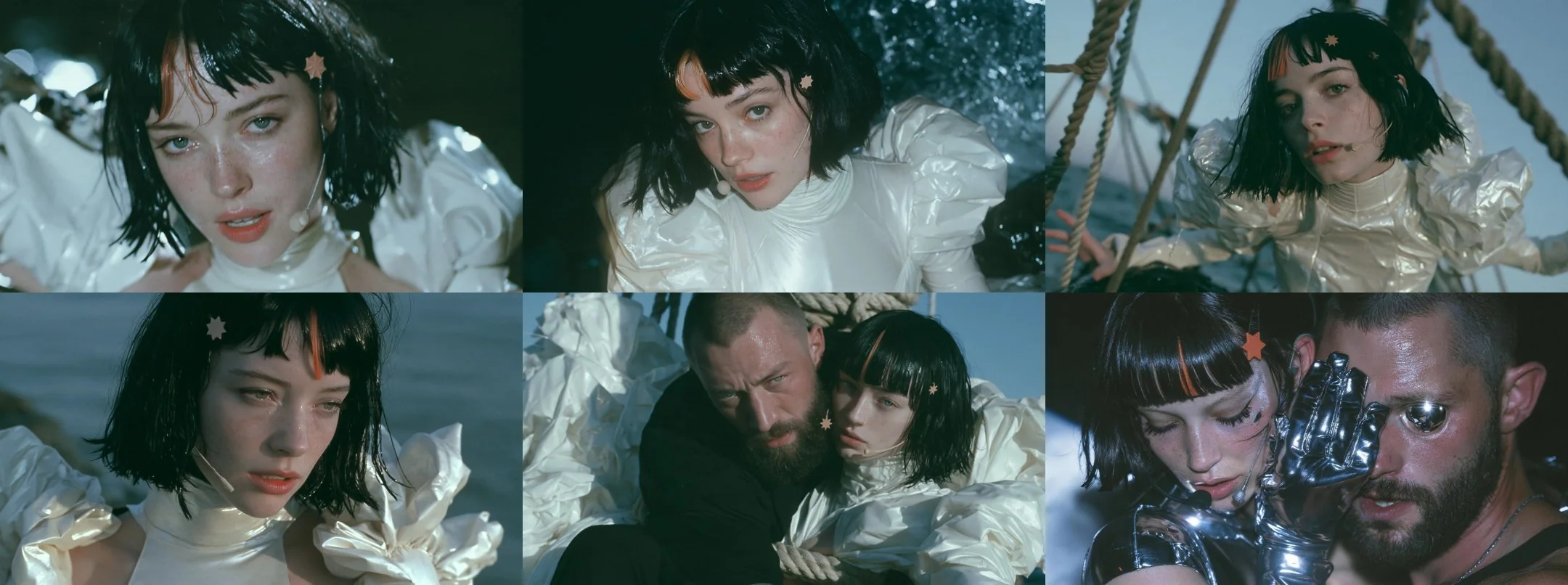
DOWNFORCE kept one look for the whole film, the pilot's: "a fitted white racing suit with thin clay-orange piping and a high collar, white racing gloves, no lettering on her clothes", with "closed to the throat" added to the collar in the video prompts. "No lettering" didn't stop Midjourney from printing patches, badges and numbers on some suits, and two look-test suits had a keyhole cutout; those were screened out, and the video prompts close the collar and add "no badges".
DON'T LET ME SCROLL dressed her as the feed changes her: oversized white satin pyjamas in the bedroom, an oversized white men's shirt over three skirts (lavender, white satin, black) through the scroll, green mohair, black with a blazer, and a red coat dress for the escape. The director held the clothes to the film's time: "no more silver pajamas by this point please", and of the shirt look, "this is a better outfit, but dont use this earlier". Most of the takes were shot before the looks changed, so Seedance re-dressed them: the take is the edit's master for her face, body and every movement, and the picked look's still is "used only for the outfit" (Seedance).
WHITEPILL found its one look in stills before any take was made with it. The previz performer's tight green suit had pulled her build off the canon in the first takes, and a shirt tried straight in a take fared no better: "hm dont love the shirt. […] maybe something else that is still feminine and cool here besides the white tank... can you try like 3 totally idfferent outfits? i want it to be unmistakably feminine […]". Then: "can we do a mini white trad dress? can you show me the images of the outfit before generating this time". The image-edit model's dresses didn't settle it ("maybe use some different image models tbh - could try midjourney"), and Midjourney's did: "I like A1 the most". The pick had two star clips and her streak on the wrong side, so the reference made from it is mirrored, with one clip. Every prompt of hers then carried it in words:
She is very tall and very skinny, with long thin legs, thin arms and a narrow waist, and a natural, relaxed neck and shoulders. She wears a white cotton milkmaid mini dress with a ruffled, lace-edged square neckline, a fitted lace-up corset bodice with silver eyelets and a white ribbon, big puffed short sleeves with ribbon ties and lace cuffs and a full two-tier ruffled skirt with lace trim, with white leather square-toe Mary Jane shoes.
AERO kept one look for the whole film, the one its Midjourney prompts gave her from the second round on and its first image-model frames of her kept. Every prompt of her carried it in words, and the headset microphone is gone: her design sheet without it was the reference for every frame of her.
a cropped glossy white puffer jacket with silver iridescent panels over a pale aqua fitted top, pale aqua high-waisted wide-leg trousers and white chunky sneakers
Three bodies, one face
THE CAKE IS NOT A LIE's opening message asked for her as Portal's test subject ("We should make chell be Claudia"); her outfit stills followed, and then the director turned it round: "I imagine Claudia is glados and we use her style and head etc modified from the source shots". Two looks were tried on frames of Portal 2, A her own face and B porcelain, and the director: "b is great close up". So in this film her face is smooth white porcelain, and the bob, the streak and the clip are hers. Her look's text, pasted into every image prompt of her:
her face as smooth glossy white porcelain plating with fine panel seams running down both cheeks and a separate mechanical jaw piece at the chin, light freckles printed on the porcelain, warm amber glass eyes with a soft inner glow, natural soft lips, and her real hair: the glossy black blunt bob with heavy straight bangs, the one clay-orange streak through the bangs on her right side, and the small flat clay-orange eight-pointed star clip above her left temple. Her identity, from her canon: a 28-year-old Caucasian American woman with a grown-up angular face, defined cheekbones and a strong jawline, pale skin and light freckles, a glossy black blunt jaw-length bob with heavy straight bangs and one clay-orange streak through the bangs, a small flat clay-orange eight-pointed star hair clip, a thin headset microphone at her cheek. In this film she wears no headset microphone: none appears anywhere. The same grown-up adult face in every view, a woman of about 28 to 30, never childlike.
The canon stays word for word; what this film changes comes after it, as a sentence of its own (no microphone here). The story gives that one face three bodies, and every video prompt pastes the same face text, adapted only by body:
- GLaDOS-Claudia on the boom: her head, large, on GLaDOS's black robotic neck and cable bundle with orange stripes, hanging from the white ceiling ring of her dark chamber; from the second verse grown, with more cables, amber-eyed cores, compute modules and white panel arms.
- Her crab body, the crab walker of her memories: her head, a little smaller than life, on a cat-sized walker of white Aperture shell panels with black joints and an amber status light.
- The Claudia-bot: her head on a humanoid body of glossy white Aperture plating with black joints; in France, a beige trench coat and a cream scarf over it.
Each body has a character sheet made by an image model (GPT Image 2.5, 55 images with the other characters' sheets, $3.75 at list), hers always from a blank grey canvas with her porcelain look-B close-up among the references, so the face can't drift between bodies. The crab walker's sheet, as it ran:
The first image is a blank light-grey studio backdrop. On it, make a character reference sheet of [the crab walker], a small scrappy robot made from Aperture Science parts: her porcelain robot head, a little smaller than life size, mounted on the front of a small crab-like walker about the size of a house cat: a compact rounded body of glossy white shell panels with black seams like Portal 2's turrets, black articulated joints, six thin jointed black legs like a turret's legs (Portal 2's frankenturret), and one small amber status light on its back. Cute, scrappy and determined, unmistakably Aperture-made.
(then her look's text, the four views, "Alert, determined expression, lips closed." and the studio-sheet paragraph; square brackets mark an edit of the working name.) What to watch on the sheets: the views of one sheet can disagree on which side the streak is on. One head sheet's front view swept the streak to her left, and the image model copied that over the words when the sheet was its reference; the sheet that agrees with the canon on both sides is the one to give it (What to build). The Claudia-bot's first rolls came back off her design sheet, and the sheet's text was tightened before a pick.
Her game avatar
AIRPLANE MODE, the fourth film, needed her inside a video game. The director: "there are multiple tiers of virtual claudia: the real looking one … the low poly ones." So she has two tiers there:
- The realistic Claudia, the canon above, in the real world and the first simulation.
- Her game avatar, in the deeper levels: a cel-shaded 3D anime game heroine with the same head constants, in the film's orange flight suit.
How the avatar was found:
- The first game shots used a low-poly 3D model of her built for the film. The director: "it feels like roblox lol". The model became a motion reference only (Seedance).
- The director picked a stylised plate of her from one of the film's episodes, "much closer to the claudia avatar i imagined". It became the style and image reference for a Midjourney sheet of the avatar: front, side and back views, a face, poses.
- That plate wore the episode's blazer and tie. The avatar was remade in the film's orange suit, and the blazer stayed inside its one episode ("just flagging so she doenst have a blazer for the full video").
- The first sheets came out chibi: a head about a quarter of her height reads as a child. The remake states the proportions in words: "a grown woman with ADULT proportions: a slim tall figure, long legs, her head about one seventh of her height".
The avatar's text, as it ran in the video prompts:
a slim adult woman with long legs, her head about one seventh of her height; large dark anime eyes with sharp lashes, small brows, a small confident smirk, pale skin; a glossy faceted black bob with heavy bangs and one big clay-orange streak; a thin black headset microphone; white gloves; a plain vivid orange flight jumpsuit with a silver front zip, thin silver piping, a wide white belt and white chunky sneakers. Cel-shaded 3D anime game character, crisp faceted shapes, glossy hair, clean toon lighting.
- One still of her per world. For each game shot, Midjourney made a still of the avatar inside that shot's world: a frame of the shot as the style reference, her front view as the image reference. It tells the video model how the world looks and how she looks in it.
- Screen the avatar like her: adult proportions, one streak, the headset, the suit. A chibi still is thrown away before anything is built on it.
When an image reference is right
Once: for the Mask, a colossal porcelain sculpture of her face. A sculpture has to look like her more exactly than a
person in a crowd does, and text alone made a generic face. The Mask prompts used her face sheet and the picked Siren
plate as image prompts, weighted --iw 0.75 for close shots and --iw 0.4 for wide ones. Everything else about her
stayed text-only.
AIRPLANE MODE added a second case: her stylised game avatar, a drawn character rather than her photoreal face, made from a picked stylised plate as the style and image reference (Her game avatar). The realistic Claudia in that film stayed text-only.
DOWNFORCE added a third, in the video model rather than Midjourney: video edits that put her into Tesla's real footage need her look as an image. Her plates for them were made from the canon text like any other: one full length, one of her face. Given both, the edits cut to the face plate as if it were a shot, her face on its grey studio wall. From the second round each edit had one cleaned full-length plate, "only a reference for her look; it is never shown as a shot", and the canon's short form in the prompt.
DON'T LET ME SCROLL added a fourth, for her face itself, and only at the very end. Its last repairs re-drew finished shots in Wan, and the re-drawn face drifted: "1:11 and 0:36 reshoots lose her face consistency - can you feed in a good face ref? […]". The production showed three candidates, and the director picked DOWNFORCE's identity portrait ("face 1 is best pic there"), cropped to her face and hair so its racing suit couldn't bleed into the outfits. The prompts add it as "Image 1 is the face of the woman … Image 1 is only a reference for her face; it is never shown as a shot." It fixes who she is, not her pose: in one shot her chin was tucked into a sweater's collar and her face still read full until the prompt lifted it (Seedance).
WHITEPILL made the face sheet her identity in every video take, a fifth case. The previz performer saw only a large front view of her face, for her eyes and lips, through the holes of a green hood. The masters got the whole sheet, ten panels (front, three-quarter, profiles, back and expressions), after a test with only one large face crop: "you should give a full face sheet like this next time. otherwise it makes her neck all hitched lol". Its role in every prompt: "@Image1 is Claudia's face from every angle: identity only, never shown as a frame; do not use its white tank top or grey studio." The canon text stayed in every prompt beside it, and a picture of the dress from four sides carried the clothes. Midjourney worked from images of her too: the colony's plates were edits of an image of her ("keep this woman"), and the dress batch re-dressed two of DON'T LET ME SCROLL's plates of her for her height. One service refused the sheet outright: on Replicate it was refused by the provider's content filter even alone, so the palette tests there ran without it, on the canon in words.
THE CAKE IS NOT A LIE added a sixth: an image-model edit that puts a face back on its sheet. Its storyboard frames came from Midjourney, which doesn't hold her face, and the director: "we can replace her identity to be back to something like the porcelain version of our character sheet via gpt-image-2.5 sunburst again after the reimagine." Each frame where a recurring character is seen went through GPT Image 2.5 with the frame first and the sheets after it: "Keep this photograph exactly as it is … Change only the robot woman's head and face, to match her in the second and third images", her look's text, and the sentences for the sides and for how her head hangs (What to build). In the video takes, one image of her per take, its first frame; the memories on her screens came as images with no face in them.
AERO added a seventh: her design sheet beside a first frame, in the video model. Its first frames of her were image-model edits from the sheet without the headset microphone, putting her into a Midjourney world or onto flat green (Midjourney). Every take with her face then carried the sheet itself as @Image2: "use it only for her face, her hair with the one clay-orange streak, her star clip and her skin. It is never shown as a shot; its layout, its white background and its several views are not used. She is ONE person." The ending's first take, made without it from a still of her small on the grass seen from behind, drifted off her sheet when she turned to wave; with the sheet as a second reference, the next takes held (Seedance).
Fixing a plate
A plate that is almost right gets corrected at the source, then everything made from it is re-made:
- Re-roll with the same prompt; the other three images of a job are a free pool of variants.
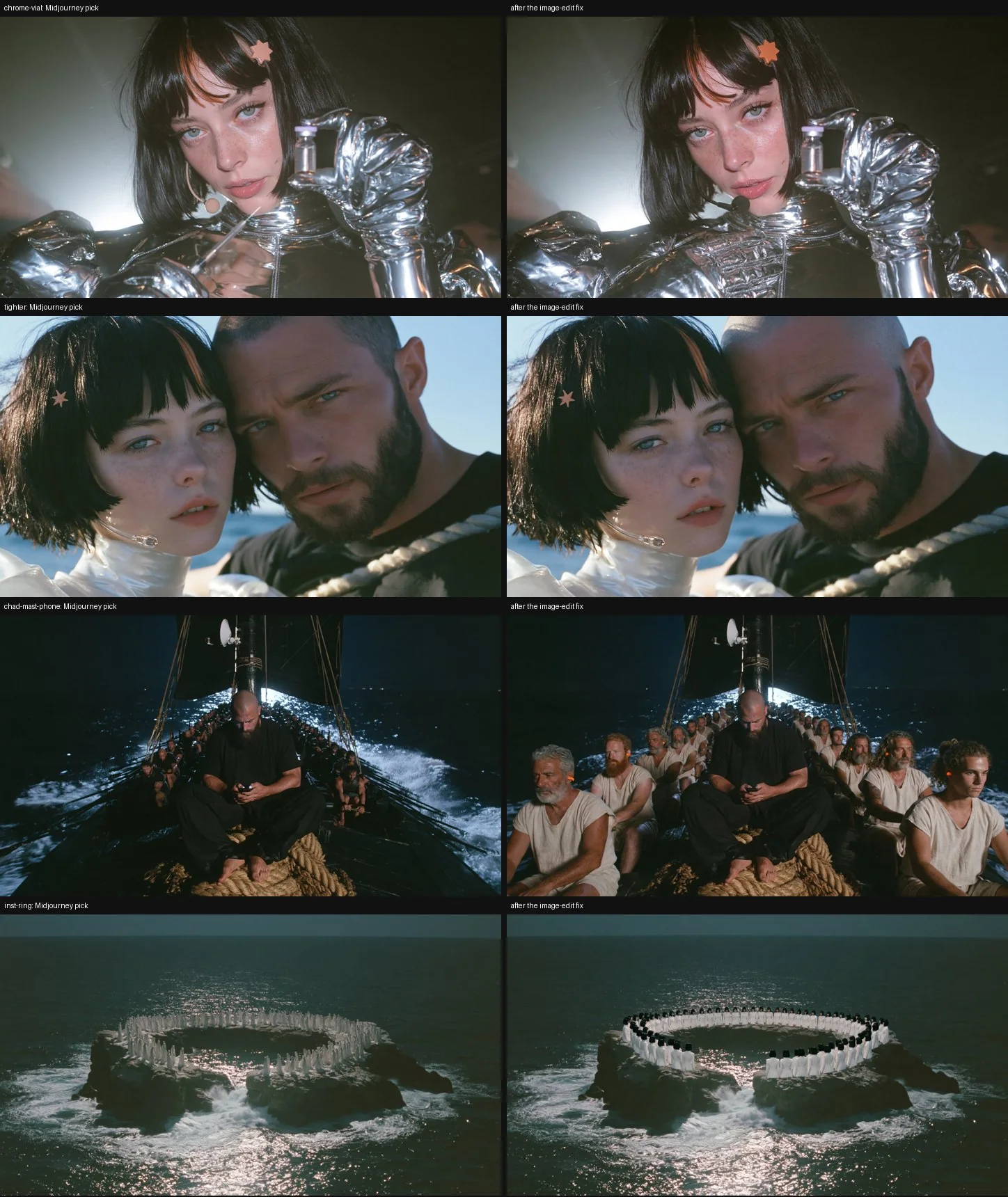
- Edit with an image model, with the Midjourney image as the first reference and the prompt listing what must stay ("keep her face, hair, streak, clip and the light exactly"). CLODYSSEY corrected 15 plates this way (16 edits, about $2.22): a syringe removed, a man's head shaved, a crew re-cast, hooded figures turned into Sirens.
- Never paint by hand, and never patch the video frames: a fix in the plate carries into every clip made from it.
Crowds and bodies
Midjourney tangles limbs and doubles faces when a frame holds many people. Make the set, and her alone in it, in Midjourney; then add the others with an image-edit model. Check every plate that will feed a video for extra fingers, a third arm, a doubled face, but don't throw away a bold pose: reject only the unmistakable failures. Once a broken body goes into a video model, the error moves and gets worse.
In motion
Seedance 2.5 keeps her when her plate is the first frame. The prompt then states it in plain words:
Use @Image1 as the first frame. This first frame defines Claudia's appearance and wardrobe, her pose, the set, the light and the camera direction. Keep Claudia's identity, face, hair with one clay-orange streak, star clip, headset microphone and wardrobe exactly as in @Image1 throughout. Only one Claudia appears. Natural anatomy: natural neck and shoulders, hands with five fingers, no extra or fused fingers, no distorted limbs; normal eyes.
What still slips, and has to be checked take by take: Seedance loses her streak on some looks, renders printed fabric in the wrong colour (the sky-print gown came back lavender), and now and then changes her clothes. Two clips should never start from the same frame; vary the plate instead. Seedance has the full prompt structure.
A colour name can come back as lettering: in AIRPLANE MODE, "international orange" printed INTERNATIONAL across the chest of her flight suit. Its prompts since say "vivid safety-orange satin, plain, no lettering". In DOWNFORCE, Wan printed "9RC" on her racing suit's chest; the re-roll says "no letters, numbers, badges or logos ever appear on it".
Wan's prompts of her in DOWNFORCE open with the plate and the canon, verbatim:
Image 1 is the first frame. Keep her exactly as in Image 1: a 28-year-old Caucasian American woman with a grown-up angular face, defined cheekbones and a strong jawline, pale skin and light freckles, a glossy black blunt jaw-length bob with heavy straight bangs and one clay-orange streak through the bangs, a small flat clay-orange eight-pointed star hair clip, a thin headset microphone at her cheek; her fitted white racing suit with thin clay-orange piping and a high collar closed to the throat, white racing gloves, no lettering on her clothes; native colour. One continuous shot, no cuts: the set stays exactly as Image 1 from the first frame to the last — the same cockpit, the same seat, the same window, the same light; no new screens, no new lights, no white interior; the camera stays at the same distance. Her lips stay closed; she never talks. No text, no logos, no badges, no other people.
What slipped there: her mouth (parted lips and teeth from plates with parted lips; see Seedance), the set (a cut to another cockpit), and once her head: a close-up with a white streak beside the clay one, red-rimmed eyes and a second mic tip. The film doesn't use those seconds.
DON'T LET ME SCROLL's Wan takes of her on grey open with KEEP, {w} being the look's wardrobe:
Image 1 is the first frame. Keep the woman exactly as in Image 1 throughout: her face, her glossy black blunt bob with heavy bangs and its one clay-orange streak, the small clay-orange star hair clip, the thin headset microphone, and her clothes ({w}). Only one woman appears; natural anatomy, five fingers on each hand, no extra limbs; no text, no logos, no lettering on her clothes. The plain mid-grey studio backdrop stays empty and evenly lit. The camera is locked off on a tripod and never moves, pans or zooms; her whole body stays inside the frame from head to feet the entire time.What slipped there: things Wan drew around her gestures (a floating glass panel, focus brackets round a fingertip, a yo-yo falling onto her toes, a stool seat under her), a camera that moved although it was locked off, and limbs that left the 9:16 take's frame and had to be completed later. Her face held in the takes; it drifted only when finished shots were re-drawn whole.
WHITEPILL's Seedance takes of her open their subject with the canon verbatim, then her build and the dress (above), and "Only one Claudia appears."; her face sheet, the dress from four sides and a still of the film's look come as references, each with one role (Seedance). What slipped there came from the guides, not from her face: dance takes lost hands and legs where their previz guides had, and were made again with no guide. Her build slipped earlier, in takes redrawn over the previz, when its performer wore a tight suit with no build in words; the fix was a slim performer in a loose, thick costume, and her build written into every prompt.
THE CAKE IS NOT A LIE's takes of her start from a first frame on canon and paste her face text, adapted by body, with "Only one Claudia-GLaDOS appears." Her face held in the takes. What slipped came from around it: her eyes glowed brighter than her look in the dark shots until every prompt said they "keep only a soft inner glow; they never blaze"; a motion guide of GLaDOS's own body brought its white shell, her head set in it like a helmet, until the guide was blurred into a blockout (Seedance); and Midjourney's frames stood her head on a neck and mirrored her hair until the identity fix said where she hangs from and which side the streak is on.
AERO's takes of her start from a first frame on her design (made from her sheet, or a frame of an earlier take) and paste her canon, in full for close shots and in its short form for full-length ones, then her look and "Only one Claudia appears."; the sheet comes as the second image. In the takes that had her sheet, her face held. What slipped came from the inputs: a face invented when a back view turned to the lens with no face reference; the crown of her bob, faded into the green by a first frame and carried into every frame of the takes made from it; and one take that turned her back through a sung line and came in closer than its first frame. Where a take carries on from another, it starts on the other's own frame at that moment: her last line in her call starts on the frame her call had reached there.
The check before anything is built on a plate
- one streak, clay-coloured, in the bangs
- the star clip and the mic
- an adult face, and the ethnicity in the text
- for a stylised version of her, adult proportions: the head about a seventh of her height
- closed lips on any plate for a film where she doesn't sing
- natural anatomy at 100%, and at 800 px or more for a pick (a 230 px thumbnail hid a third arm)
- no text, letters or logos (Midjourney's lettering is garbled; type is drawn in code)
- her look matches the world, with no stray orange
- not a near-duplicate of a plate already used
- for a take that will be cut out: her alone on plain grey, her whole body inside the frame with room to move
- for a video take with no first frame of her: her whole face sheet, never a single face crop, and her dress from four sides
- for a short dress: no low camera angles looking up under it
- a prompt with a child in it: the child only as what they are, no words about anyone's body
- for a porcelain face: one streak, through the bangs on her right; the clip above her left temple; no eye makeup
- for her head on a boom: she hangs from above, and nothing holds her from below the chin
- one of each character in a frame, and her face in one image per video take
- for a video take in which her face may show, even small or from behind: her design sheet beside the first frame
- a close-up that will be shown large: a 1080p take, never a 720p one scaled up
- for a take to be cut out: one flat green from edge to edge in the first frame, her whole crown inside it, and room above her raised hands
- a take that carries on from another: the other take's own frame at that moment as its first frame